
By Grace Downie, Senior Clinical Psychologist
There’s a particular kind of work exhaustion that doesn’t come from one bad day. It builds up over time, each day manageable on its own, but never quite fully processed before the next one arrives. For some, exposure to trauma is part of the work itself.
Police officers may repeatedly encounter violence, death, or serious injury. Frontline doctors, nurses and paramedics may care for people at the most frightening point of their lives, witnessing suffering and death. Fire and emergency personnel can repeatedly find themselves responding when other people are in danger.
Then there are professions such as lawyers, journalists, advocates and investigators where trauma exposure is less direct, arising from hours spent examining distressing information, images or accounts of what has happened to others.
These roles are very different. But they all share something important. They can involve repeated exposure to human suffering and distress, whilst requiring you to keep calm and carry on when others are frightened or overwhelmed.
Being prepared for this kind of work doesn’t mean being immune to its effects. Over time, repeated exposure to others’ distress may impact your wellbeing, mental health, and relationships. The impact doesn’t always look the same. For some it may lead to vicarious trauma, whilst others may experience burnout or compassion fatigue. These experiences can overlap, but they aren’t quite the same thing.
in short…
When your job involves regular exposure to trauma and distress, it can be difficult to leave work at work. Burnout, compassion fatigue, and vicarious trauma can develop. So how can you look after your own mental health whilst supporting others? This article outlines the costs of a helping profession, and ways to reduce the impact of your work on your wellbeing and personal life - even the strong need support.
what is work-related trauma? who is most likely to experience it?
Work-related trauma is a broad term for the psychological, emotional, and physical impact that can occur when your work involves exposure to violence, harm, severe stress, traumatic events, or others’ traumatic experiences.
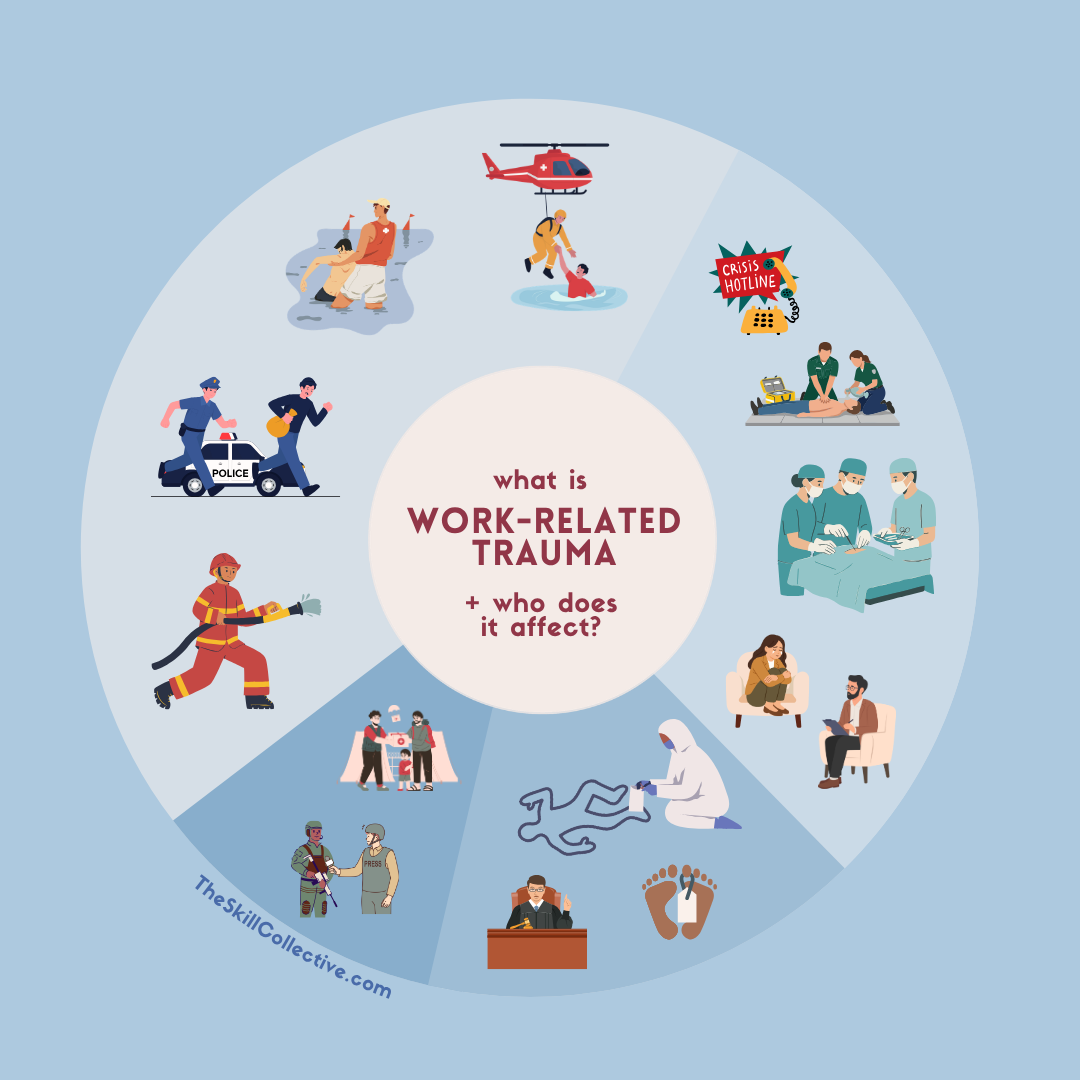
The exposure can be direct, in the case of witnessing serious accidents or attending to those who have been seriously injured or dying, as in the case of emergency workers.
The exposure can also be indirect, such as in roles where you are repeatedly hearing detailed accounts of trauma, reviewing traumatic material, or working closely with people who have experienced traumatic event.
Work-related trauma exposure is different from trauma caused by the workplace itself. Bullying, harassment, unsafe conditions, or other organisational problems can negatively impact mental health, however this article focuses specifically on the impact of being exposed to trauma through the work you do. These occupations most commonly include:
Police, fire, and emergency services
Paramedics
Doctors, nurses, psychologists, and other healthcare professionals
Lawyers working with traumatic cases
Journalists covering violence, disasters or other traumatic events
Advocates and support workers
Investigators who regularly review traumatic records, images, or accounts
Direct and indirect exposure may be different experiences, but both can affect your mental health.
What are some signs that work-related trauma is affecting your life?
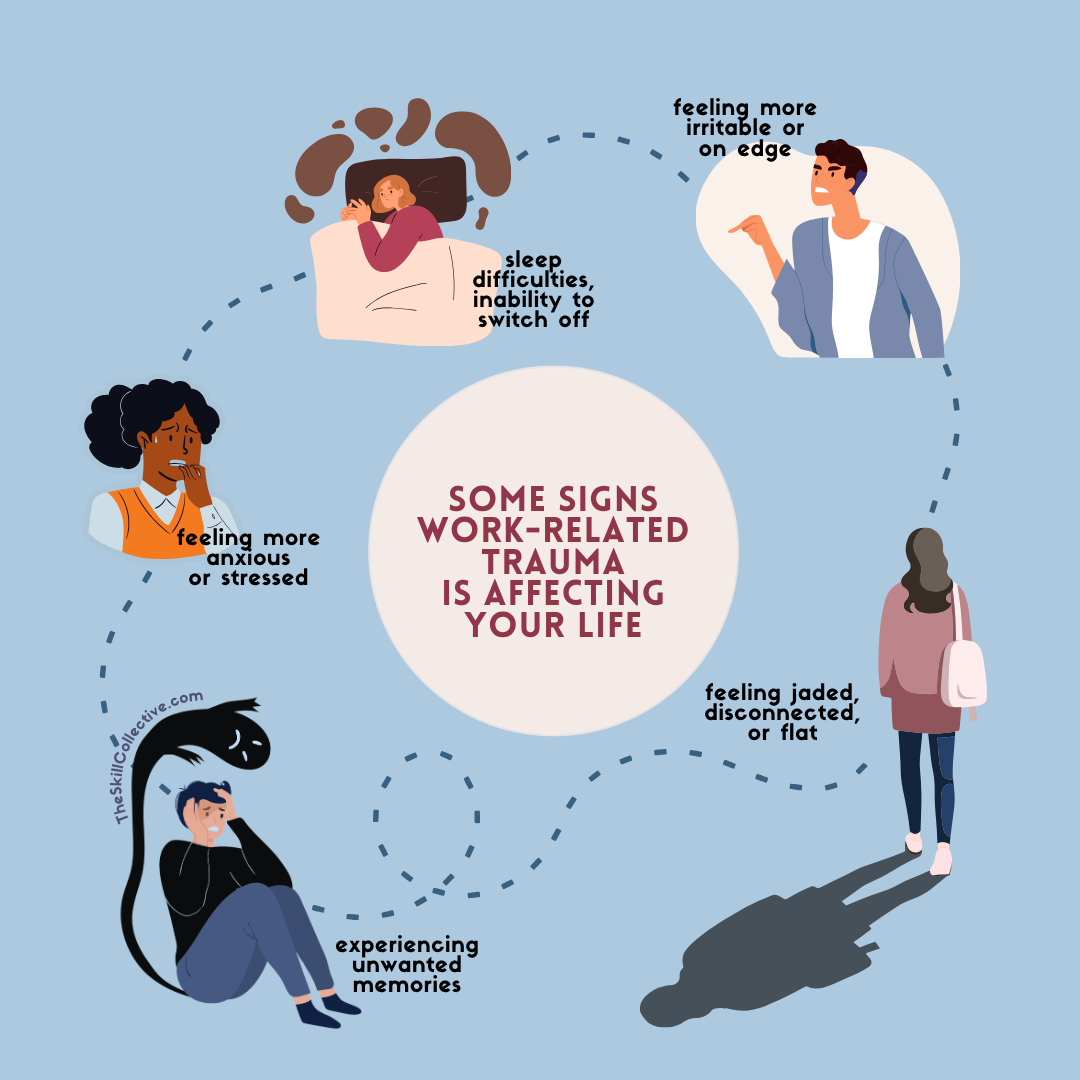
The impact of regularly facing trauma and distress at work isn’t always obvious at first. You may still be showing up, doing your job, and functioning well on the outside but notice that something has gradually changed beneath the surface:
You feel more jaded, flat, or disconnected
You find it harder to concentrate or switch off after work
You feel more irritable, impatient, or on edge
You’re having difficulty sleeping
You’re withdrawing from people and activities you usually enjoy
You’re feeling more anxious or stressed
You experience unwanted memories or find that reminders of what you’ve seen or heard are hard to tolerate
You notice your sense of safety, or how you see yourself or the world has changed
Whilst none of the above symptoms on its own means you have a particular condition. They are signals that your work may be starting to affect you and your life, and are worth paying attention to.
what’s the difference between burnout, compassion fatigue, and vicarious trauma?
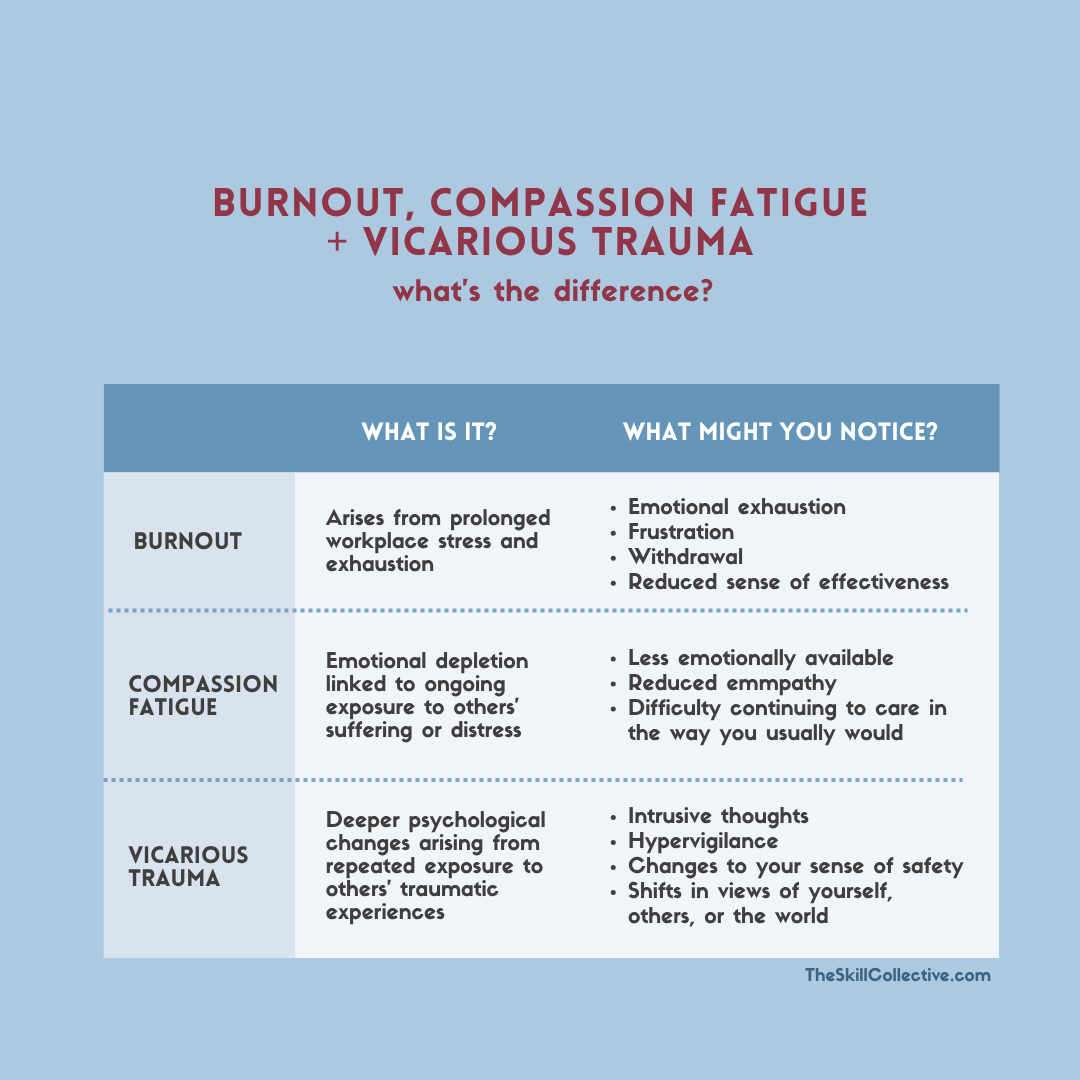
When you are regularly exposed to others’ trauma at work, you may experience burnout, compassion fatigue, and vicarious trauma. These experiences can overlap, which is why the terms are sometimes used interchangeably, but they describe different processes and effects.
burnout
Burnout is linked with chronic workplace stress rather than trauma exposure specifically. It can involve emotional exhaustion, increasing psychological distance or cynicism towards work, and a reduced sense of effectiveness.
You may find that work that was once meaningful ends up feeling draining or futile. You may find yourself pulling back, not because you no longer care, but because you simply have less to give. You may also experience a loss of confidence in your ability to do your job well.
compassion fatigue
Compassion fatigue is a broader term often used to describe the emotional toll of ongoing work involving caring for others who experience suffering, including those affected by trauma.
When there is little opportunity to pause, recover and reset, the cumulative weight of supporting others may leave you feeling emotionally depleted, less able to feel connected, or less able to access the same level of empathy and compassion you usually bring to your work.
vicarious trauma
Vicarious trauma refers to deeper changes that can occur through ongoing exposure to others’ trauma. Rather than being primarily about exhaustion, it involves re-experiencing parts of the traumatic event, increased reactivity or hypervigilance to threat, avoidance of reminders that cause distress, and can involve significant shifts in how you see yourself, others, and the world around you. Your sense of safety, control, or vulnerability can also shift.
why can it be difficult to ask for help when you experience work-related trauma?
There can be a particular difficulty in seeking help when your professional identity is built around being the person who provides support in times of distress.
One obstacle is that, over time, this way of being can become so deeply ingrained that your own needs start to feel less important. You might tell yourself:
“This is what I signed up for”
“Other people have it worse”
“I should be able to handle it.”
After spending your days helping people facing serious illness, injury, violence or the possibility of death, you may find yourself disconnected from the everyday difficulties faced by yourself and others, minimising their weight because they can feel small in comparison to what you witness at work.
Another obstacle to seeking help is that the emotional impact of your work can leave you too tired to show up, too tired to make conversation, or too tired to care for yourself because you have so little left to give.
For people in these professions the instinct is often to push on, but strength and self-sufficiency are not the same thing. Being resilient doesn't mean being unaffected, and needing support doesn't mean you aren't coping.
In fact, seeking support can be a part of staying well and maintaining resilience. Sometimes the hardest part is recognising how much you have been carrying. You may only understand the weight of it when you finally find somewhere safe enough to put it down.
What helps with vicarious trauma, burnout, and compassion fatigue?
When you’ve spent years being the person who holds things together and keeps going when things are difficult, the goal isn't to stop being strong. Your strength matters. The next step is making space for the other half of the truth: You can be strong and still need support.
What that support looks like will depend on what you have been carrying:
For someone experiencing trauma-related symptoms, therapy may involve carefully processing what happened and helping traumatic memories feel less present and threatening. Evidence-based trauma treatments, including Eye Movement Desensitization and Reprocessing (EMDR) may be considered.
For someone experiencing burnout or compassion fatigue, therapy may involve understanding the expectations and patterns that have led to exhaustion. Finding practical ways to restore boundaries, make space for self-care, and reconnect with things that give meaning and joy may help.
Sometimes, the work goes deeper than what is happening right now. It may mean looking at your sense of self and your longstanding patterns. A deep sense of capability and control may mean that you find it hard to acknowledge when you need support. Or perhaps you’ve always been responsible for caring for others, and and find it uncomfortable to receive help. These patterns don't necessarily begin with your profession. They may have roots much earlier in life, and understanding them can be an important part of learning how to care for yourself and continue your work in a more sustainable way.
Sometimes therapy begins somewhere much simpler: Having a place where you can finally say the true version of how things are going. Not the version that reassures everyone else. Not the version that says, "I'm fine." The real version.
Sometimes the people who appear to be coping the best are the ones who have become the most practised at carrying things quietly.
how to leave work at work when your job exposes you to trauma
If helping others with trauma and distress is a cornerstone of your job, below are some tips to help you leave work at work.
1. Notice when your threshold shifts
Pay attention not just to how you feel, but to what is happening to your capacity for daily life. Are you becoming more impatient with people? Is conversation feeling exhausting? Are relatively minor problems provoking a reaction that seems out of proportion? Are you increasingly withdrawing from others? These can be early signs that your reserves are running low. The point isn't to diagnose yourself — it's to notice the change before exhaustion becomes your new normal.
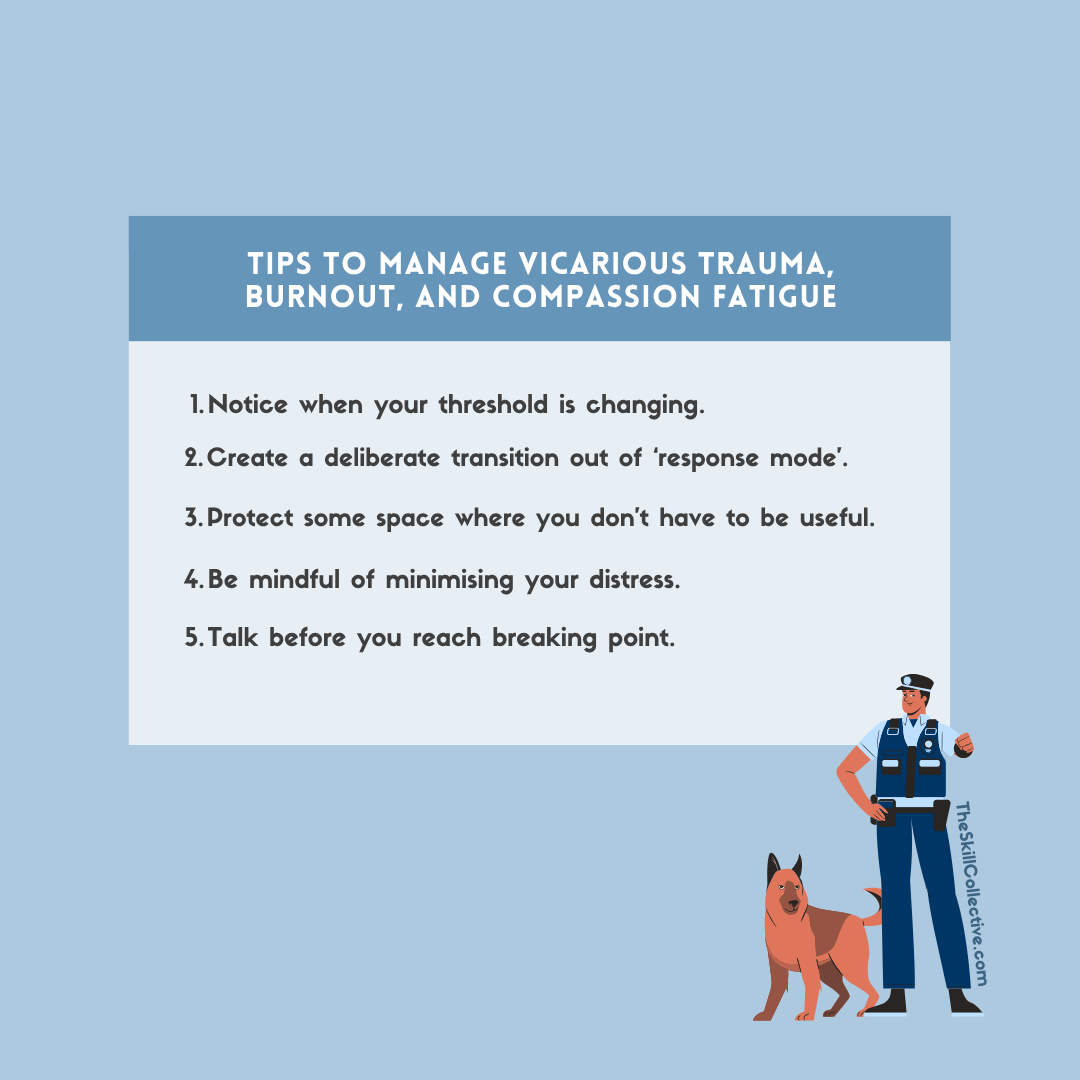
2. Create a routine to shift out of “response mode”
People who work around trauma can become very practised at moving from one crisis to the next. What can be missing is a clear signal to your nervous system that the work is over.
Rather than simply walking out of work and carrying the same state into the rest of your evening, develop a small transition ritual. It might be a walk before going home, changing clothes, sitting quietly in the car for ten minutes, or having a shower before interacting with your family. The activity itself isn't particularly important. The intention is to create a psychological boundary between what happened at work and what comes next.
3. Protect some space where your role isn’t defined by being useful
When your working life involves solving problems, managing crises or taking care of other people, even your downtime can start to feel like another task.
Try to notice whether your life outside work has become another series of responsibilities. Your time doesn’t always need to be productive, social, or restorative in some prescribed way. Sometimes what you need is space where nobody needs anything from you and you don't have to perform a role.
4. Be mindful of minimising your own distress
One of the traps I commonly see in people who work with trauma is thinking, “What right do I have to be struggling? I've seen what other people are going through.”
Someone else's suffering doesn't invalidate your own experience. You don't have to have been the person at the centre of the tragedy for something to affect you. And you don't have to wait until your experience seems “bad enough” before you deserve support. Your distress doesn't need to win a competition before it counts.
5. Talk before you hit crisis mode
You don't need to arrive at therapy with a diagnosis, a neatly explained problem or a story that feels serious enough to justify being there.
Early support isn't an admission that you're not coping. It can simply be a way of understanding what’s happening, and to put some strategies in place, before it becomes harder to manage.
When should I talk to a psychologist about work-related trauma?
In my work with people who are regularly exposed to trauma, distress and the suffering of others, I often see how difficult it can be to recognise the impact of the work while you're still in the middle of it. It may be worth reaching out if you've noticed changes are persistent, or are beginning to affect your:
Mood
Relationships
Sense of safety
Ability to switch off from work
Concentration, sleep, or daily functioning.
If these changes are something you'd like to explore, you're welcome to get in touch to find out more about working with me. You don’t need to arrive with a diagnosis; sometimes the starting point is simply noticing, “I haven’t been myself lately.”
in summary…
Some professions involve regular direct or indirect exposure to trauma as part of the work itself.
Trauma exposure through work can affect mental health, relationships, and life outside work.
Burnout, compassion fatigue, and vicarious trauma can overlap but are not the same thing.
Creating boundaries between work and home can help protect your capacity to recover.
You don't need to wait until you're in crisis to seek support.
Note: This article is intended for general education and is not a substitute for personalised medical advice. If you find that your difficulties are persistent, severe, or affect your health or safety, speak with your GP or another qualified healthcare professional.
Frequently Asked Questions
-
Work-related trauma exposure refers to the psychological impact that can occur when your work involves direct or indirect exposure to traumatic events or others’ traumatic experiences. This can happen through witnessing traumatic events, responding to them, hearing detailed accounts of trauma, or regularly working with people who have experienced trauma.
This is different from trauma caused by the workplace itself, such as bullying, harassment, discrimination, or an unsafe work environment. Whilst these experiences can also affect mental health, this article focuses specifically on the impact of being exposed to trauma through the work you do.
-
Burnout typically arises from sustained workplace stress leading to exhaustion, a sense of ineffectiveness, and feelings of detachment and cynicism about work.
Compassion fatigue often emerges from prolonged exposure to others' suffering resulting in reduced capacity and empathy, and is commonly seen in helping professionals.
Vicarious trauma describes the deeper impact that repeated exposure to other people's suffering and trauma can have. It occurs when the details of traumatic events become absorbed into the self, impacting your general functioning and your internal beliefs, shifting the way you experience yourself, other people and the world.
-
Yes. This is particularly relevant to lawyers, journalists, investigators, advocates and other professionals (including health professionals) who encounter trauma through testimonies, records, images or repeated exposure to other people's experiences.
Vicarious trauma is specifically concerned with the impact of exposure to others' trauma; it does not require you to have been physically present when the original event occurred.
-
You don’t need to wait until you’re in crisis. If the effects of your work are persistently affecting your mood, relationships, sleep, sense of safety, or ability to function, speaking with a psychologist can help you understand what’s happening and decide what support you need.
Tailored support
If you work in a role that exposes you to trauma, and want tailored support in creating healthier boundaries between the work. you do and the life you return to, why not reach out to us? Below are some of our psychologists who can help with this presentation..





References
Berger, W., Coutinho, E. S. F., Figueira, I., Marques-Portella, C., Luz, M. P., Neylan, T. C., Marmar, C. R., & Mendlowicz, M. V. (2012). Rescuers at risk: A systematic review and meta-regression analysis of the worldwide current prevalence and correlates of PTSD in rescue workers. Social Psychiatry and Psychiatric Epidemiology, 47(6), 1001–1011. https://doi.org/10.1007/s00127-011-0408-2
Cohen, C., Pignata, S., Bezak, E., Tie, M., & Childs, J. (2023). Workplace interventions to improve well-being and reduce burnout for nurses, physicians and allied healthcare professionals: A systematic review. BMJ Open, 13(6), e071203. https://doi.org/10.1136/bmjopen-2022-071203
Cocker, F. M., & Joss, N. (2016). Compassion fatigue among healthcare, emergency and community service workers: A systematic review. International Journal of Environmental Research and Public Health, 13(6), 618. https://doi.org/10.3390/ijerph13060618
Greinacher, A., Derezza-Greeven, C., Herzog, W., & Nikendei, C. (2019). Secondary traumatization in first responders: A systematic review. European Journal of Psychotraumatology, 10(1), 1562840. https://doi.org/10.1080/20008198.2018.1562840
Iversen, S., & Robertson, N. (2022). Prevalence and predictors of secondary trauma in the legal profession: A systematic review. Psychiatry, Psychology and Law, 28(6), 802–822. https://doi.org/10.1080/13218719.2020.1855270
James, C. (2020). Towards trauma-informed legal practice: A review. Psychiatry, Psychology and Law, 27(2), 275–299. https://doi.org/10.1080/13218719.2020.1719377
Koutsimani, P., Montgomery, A., & Georganta, K. (2019). The relationship between burnout, depression, and anxiety: A systematic review and meta-analysis. Frontiers in Psychology, 10, 284. https://doi.org/10.3389/fpsyg.2019.00284
Maslach, C., & Leiter, M. P. (2016). Understanding the burnout experience: Recent research and its implications for psychiatry. World Psychiatry, 15(2), 103–111. https://doi.org/10.1002/wps.20311
Wilson, G., Farrell, D., Barron, I., Hutchins, J., Whybrow, D., & Kiernan, M. D. (2018). The use of eye-movement desensitization reprocessing (EMDR) therapy in treating post-traumatic stress disorder—A systematic narrative review. Frontiers in Psychology, 9, 923. https://doi.org/10.3389/fpsyg.2018.00923
Perimenopause - or the period of transition into menopause - can be a time of great upheaval when it comes to the physical, mental, and social aspects of life.