
OUR APPROACH
At The Skill Collective we’re committed to helping people build skills for better wellbeing, mental health, and performance. We see mental health as spanning the entire continnum of psychological health, from moments when we are thriving in life and are resilient, all the way through to when we are struggling with poor mental health and psychological illness. Here’s how we can help:
Finding clarity - making sense of your experience
First, we help you make sense of what’s going on for you. That is, we help you see what’s going on internally (e.g. how you think and feel), and externally (e.g. workloads, situational events). We get that you want to make changes, and this approach helps you see what is keeping you stuck where you are at the moment.

2. helping you build skills for better wellbeing, mental health, and performance.
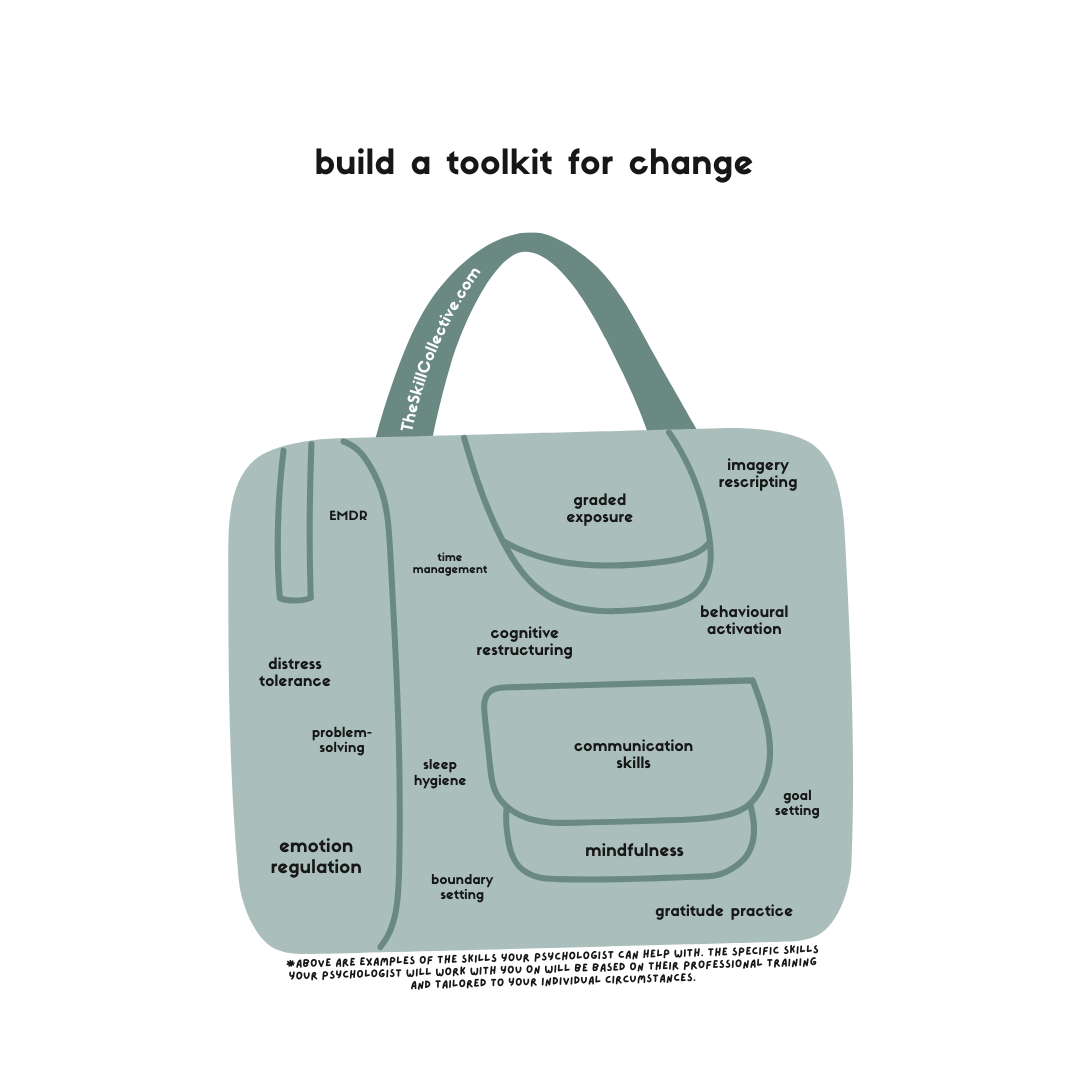
Second, we strongly believe in helping you build skills for better wellbeing, mental health, and performance. We take a holistic approach, and depending on what you’re coming in with we may look at a combination of
Shifting an unhelpful mindset;
Learning specific skills (e.g. emotion regulation, public speaking, exam preparation) and making practical changes to decrease overall stress, and
Looking at making small changes to those aspects of physical health that have positive impacts on mental health.
We are committed to helping you build skills that are backed by science and our clinical experience, and drawn on evidence-based techniques from:
Cognitive Behaviour Therapy (CBT)
Acceptance and Commitment Therapy (ACT)
Mindfulness
Positive Psychology
Solution-focused Therapy
Schema Therapy
Emotion regulation
Motivational interviewing
3. helping you make practical changes.
We believe in making practical changes. Rather than discuss a vague concept and leave it up to figure out how to use apply it in real life, we step you through applying the skills using examples relevant to your life, and continue working with you to change behaviour and mindset. Examples may include:
When streamlining your life to reduce burnout, we step through the various areas of your life that may contribute to burnout and map out a concrete plan with you (e.g. If difficulties setting boundaries leads to burnout we help you to work through specific thoughts, as well as practising boundary-setting skills).
When working to reduce anxiety, we focus not just on ‘feeling the fear but doing it anyway’, but look at helping you to identify triggers, examine and shift thoughts that increase your anxiety, cover ways to reduce panic symptoms, and help you to approach your fears in a systematic and gradual way.
4. Helping you to make sustainable changes.
We get that making sustainable changes can be challenging, which is why we help you identify potential obstacles, work to turn changes into longer-term habits. For this, we see psychological therapy as falling into different phases:
(A) Discovery (exploring causes) in the initial sessions as you explore reasons for your challenges,
(B) ‘Active treatment’ where you learn new skills and shift old patterns, and
(C) Maintenance where you embed these changes in the longer-term.
All of these phases play an important part in making changes sustainable, but perhaps none more so than Maintenance. In this phase you try out your skills over a longer period of time, allowing you to:
Troubleshoot across different situations. Sometimes the challenges only occur periodically (e.g. Difficult family communications at Christmas with particular family members, difficulties with communicating with an angry boss).
Turn new skills into habits. We get that change can be challenging, and in the Maintenance phase we work with you to turn skills into longer-term changes. Often this requires a mindset shift to increase motivation, or even working in a practical way to shape your physical environment to embed the changes in the longer-term.
If you'd like to work with us please CONTACT US to make an appointment.